


Three days in Sorrento is not too much. It is just enough — if you know where to go and, just as importantly, where not to bother. This is not the guide that sends you to the same viewpoint as everyone else, or into the same overpriced restaurant on Corso Italia. This is the guide written by the people who live and work here, on Via San Cesareo, in the heart of the old town, since 1905.
Sorrento is a place that rewards slowness. The travellers who love it most are the ones who walk without a plan, who follow a smell down a side street, who sit with a cold glass of something lemon-scented and let the afternoon go wherever it wants. Three days gives you exactly that: enough time to breathe.
Day 1 — The Old Town, the Flavours, and the First Impressions
Start where Sorrento has always started: on foot, in the old town. Leave your map in the room. Walk Corso Italia, turn into Via San Cesareo — the narrow covered street that has been the town’s main artery for centuries — and let yourself get lost in it.
The shops here are not all the same. Alongside the ceramics and the leather, look for the ones that are still making things. A woodcarver shaping inlaid marquetry panels. A soap maker with bars stacked in towers of green and yellow. And, at number 49, the Limonoro factory shop — where you can walk in, taste everything on the counter (limoncello, crema di limone, meloncello, pistachio liqueur, chocolate truffles, lemon biscuits), and buy nothing at all if you like. No booking, no ticket, no pressure. It is, as far as we know, the only place in Sorrento — perhaps in southern Italy — where a producer opens the counter completely, every day, for anyone who walks in.
This is the right moment to understand what Sorrento tastes like. A proper IGP limoncello made with hand-peeled lemons from the hills above the town is not the sweet, syrupy thing you might have tried elsewhere. It is sharp, aromatic, intensely lemon. Taste it cold and you will understand why people come back for it.
In the afternoon, walk down to Marina Grande — the old fishing harbour on the western side of town, a fifteen-minute walk from the centre. It is quieter than the main marinas, with painted boats pulled up on the beach and a few restaurants serving fish that came off those same boats this morning. Sit here for an hour. Order something with mozzarella. Watch the light change on the water.
In the evening, the town is yours. Sorrento after dark is calm and safe — the piazzas fill with locals as well as visitors, and the narrow streets of the centro storico are exactly as good to walk at 10pm as they are at 10am.
Day 2 — Into the Peninsula: Swimming, History, and Silence
On day two, leave the town behind. The Sorrentine Peninsula stretches west of Sorrento for another twenty kilometres, and most visitors never see any of it. This is where the real landscape is.
Start at the Baths of Queen Giovanna — Bagni della Regina Giovanna — about three kilometres west of the centre. You can walk there in under an hour along a trail through olive groves and past the ruins of the Roman Villa of Pollio Felice, one of the most dramatically situated ancient buildings on the entire coastline. At the end of the path, the sea has carved a natural pool into the rock: a sheltered turquoise bowl connected to the open water by an arch. Swim here in the morning before anyone else arrives. Bring water and a hat. Wear shoes you can walk in.
In the afternoon, drive or take the local bus further along the peninsula to Marina della Lobra, the fishing harbour of Massa Lubrense. If Marina Grande is quiet, Marina della Lobra is practically silent. A church rebuilt in 1528 overlooks the boats. A fresco of the Madonna, salvaged from an older church destroyed by the sea, hangs inside. The lemon groves on the hillside above belong to families who have been farming here for generations — one of them, Nello, still sells lemon plants from his terrace, and will tell you the legend of the Vervece Rock rising just offshore if you have time to listen.
From Marina della Lobra you can rent a small boat and explore the coastline from the water, which changes the perspective entirely. The cliffs are higher than they look from land. The sea is clearer.
Day 3 — Higher Ground: Monte San Costanzo and the View That Changes Everything
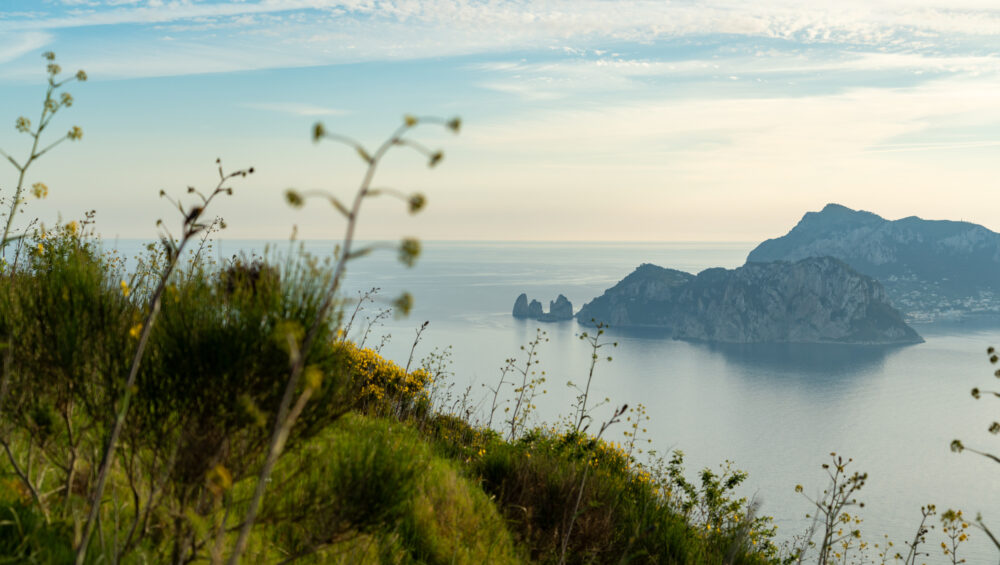
Save the best view for last. Monte San Costanzo is the highest point on the Sorrentine Peninsula, and on a clear day — which, between April and October, is most days — you can see Capri close enough to feel you could touch it, the full arc of the Amalfi Coast, Mount Vesuvius, and on the clearest days the mountains of Cilento to the south.
Drive up to the parking area (type Monte San Costanzo into Google Maps), then walk the last stretch on foot through Mediterranean scrub. There is a small white chapel at the summit, and a silence that is not the absence of sound but the presence of something larger. The videos we filmed here did not capture it. You have to go yourself.
Come back to Sorrento in the early afternoon. Use the last hours to do whatever you did not get to do — another walk through the old town, another stop at Limonoro to pick up something to bring home (the lemon cream travels well; so does the limoncello in the plastic bottles, which are lighter for carry-on luggage). Sit somewhere and eat gnocchi alla Sorrentina, the dish the town invented: potato gnocchi baked with tomato, basil and mozzarella. Order it where it is made simply and without ceremony.
Three days. That is how long Sorrento takes to get under your skin. Most people wish they had stayed longer.
Before You Go — A Few Practical Notes
For gnocchi alla Sorrentina, avoid the tourist menus on Corso Italia and look for the smaller trattorias in the side streets.
The Baths of Queen Giovanna are free to access but the path requires walking shoes. Go early or late to avoid the heat.
Marina della Lobra is best reached by car or the SITA bus from Sorrento centre. The journey takes about 20 minutes.
Monte San Costanzo: drive to the parking area, walk the last 15 minutes on foot. No entrance fee.
Limonoro is open daily on Via San Cesareo 49, in the heart of the old town. Walk in any time. Tasting is free.