

Every year, millions of people choose all-inclusive holidays in Italy — resorts on the Adriatic, in Sicily, along the Sardinian coast. There is nothing wrong with that. A week at a resort with meals included and a pool that does not require you to make any decisions is a legitimate and enjoyable way to rest.
But if you are reading this, you are probably considering something different. Sorrento is not a resort town. It does not have a single all-inclusive hotel. What it has instead is something rarer: the conditions for a different kind of holiday entirely.
What All Inclusive Actually Gives You
An all-inclusive holiday gives you certainty, convenience, and a known cost. You know where you will sleep, what you will eat, what you will pay. The pool is steps from your room. The beach is managed. The excursions are organised.
What it does not give you — and cannot, by its nature — is contact with a place. You eat at the resort restaurant, not at the trattoria where the owner’s grandmother’s recipe is on the menu. You swim at the resort beach, not at the natural sea pool three kilometres from a lemon-scented village. You taste the local product from a bottle in the minibar, not from the hand of the person who made it.
This is not a criticism. It is a description of a trade-off that only matters if the contact with the place is something you want.
What Slow Travel in Sorrento Looks Like
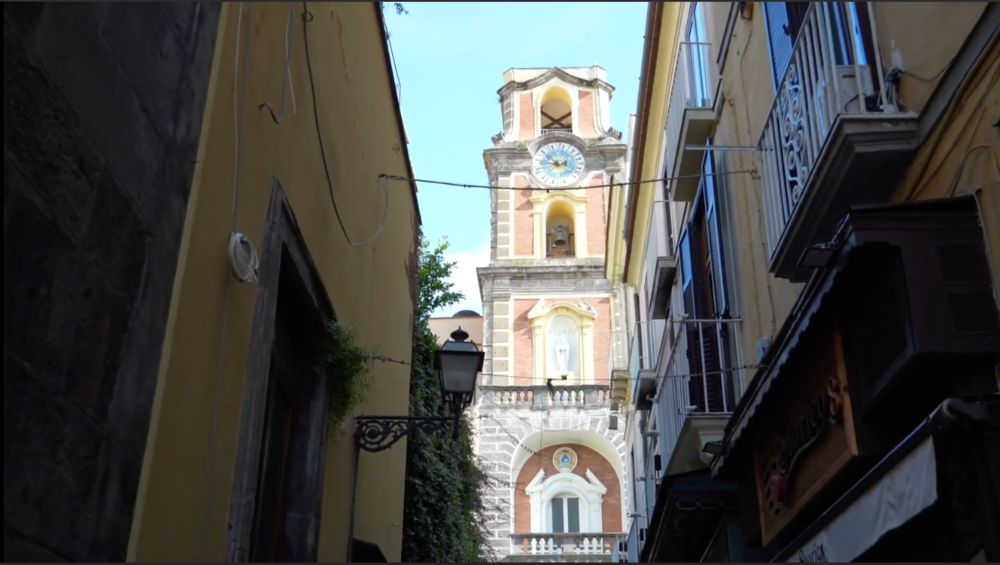
A slow week in Sorrento looks something like this. You wake up in the morning without an agenda. You walk to a bar in the old town and drink a coffee standing at the counter, the way Italians do. You wander into Via San Cesareo before the day trips arrive from Naples and the street belongs to the town’s own rhythm.
You walk the coastal path to the Baths of Queen Giovanna through olive groves and past Roman ruins, and you swim in a sea pool that has no entrance fee and no facilities and is, for that reason, completely your own. You take a bus along the peninsula to Marina della Lobra and sit by the fishing harbour and eat lunch at a place with four tables and a menu that depends on what was on the boat this morning.
You come back into town in the afternoon and walk into a shop where someone pours you a cold glass of limoncello and invites you to taste everything on the counter, because that is simply how they operate, and you do not pay for any of it. You buy what you love and leave with it wrapped.
In the evening, you order gnocchi alla Sorrentina in a restaurant that does not have photographs of the food on the menu, and it is as good as pasta gets.
The Quiet Luxury of Nothing Being Organised
There is a kind of holiday that is becoming rarer and more valuable: the one where nothing is laid on for you, where you have to be a little curious and a little brave, and where the reward is a kind of contact with a place that a resort cannot manufacture. Travellers who seek this are starting to use a term for it — hush-pitality, or quiet luxury — to describe the hospitality that does not announce itself, that works through quality and restraint rather than spectacle and scale.
Sorrento is full of this, if you know how to find it. The fisherman who will take you out on his boat for a morning if you ask. The lemon farmer who will walk you through his grove and explain the pergola system his family has used for five generations. The shop that has been making limoncello on the same street since 1905 and still operates on the principle that you should taste before you decide.
None of this is on a tour itinerary. All of it is available to anyone who is moving slowly enough to notice it.
A Practical Note
A slow week in Sorrento does not have to be expensive. Accommodation ranges from simple B&Bs at €80–100 per night to grand cliff-top hotels at multiples of that. The best experiences — the swimming spots, the coastal paths, the market, the tastings at Limonoro — cost nothing or very little. The money goes where you choose to put it.
If you are planning a holiday in Italy and trying to decide between the certainty of all-inclusive and the richness of somewhere like Sorrento, this is our honest advice: go slow. The places that surprise you are almost always the ones you found yourself, without a guide, on a morning when you had no particular plan.
Limonoro has been on Via San Cesareo since 1905. Come in. Taste. Take your time. That is exactly what the place is for.